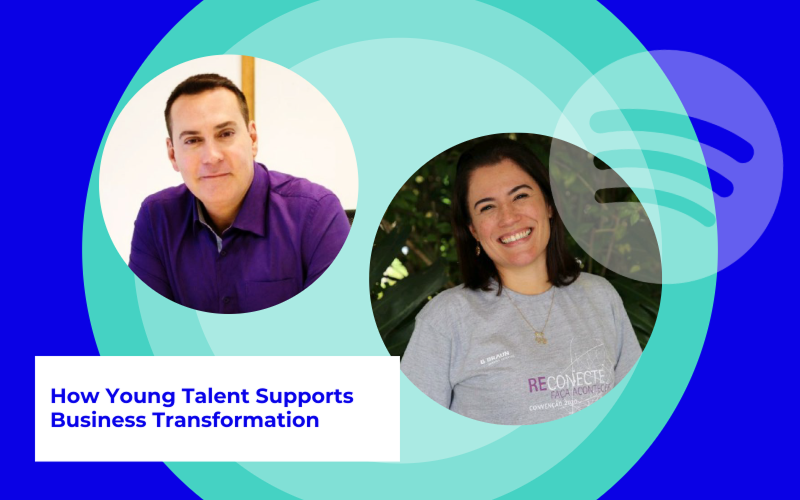
The topic for this week is a discussion agenda that really opens up a lot of debate: how do we manage to insert young professionals into the job market? With an extra twist, which is the whole issue of the pandemic.
We noticed that many of these young professionals have never had corporate experiences, have no idea what to do or how to act, and we heard a story from a great partner, B. Braun, about this.
They had a program running at full speed, a highly developed development plan, and suddenly the pandemic. So, what to do?
We invited Letícia Perozo, who is Training and Development, Culture and Innovation Coordinator, and Reinaldo Barranco, Director of Human Resources and Corporate Communication.
Both of them kindly made time in their schedules to share a little about this journey—how to support these very young,
very talented, and highly motivated people in a completely remote environment.
Before we dive into the topic, I would like you to introduce yourselves and tell us a little about who you are.
Letícia:
Good afternoon Débora, I am the one who thanks you for the opportunity to exchange and bring a little of our
learnings. When we speak, we also learn. Thank you for the opportunity, thank you to Clave.
Well, I have been a human resources professional for approximately 12 years and at B. Braun I have been working for 8
years, having built a large part of my career here. I am a professional with a background in education, I studied
pedagogy and ended up specializing in human resources, which is the area I fell in love with. In the last two years I
discovered, or rather rediscovered myself within the HR career with innovation.
I have been strongly influenced by agile models and by how HR can strategically support business areas through
methods. Not only looking at people in people management, but also through agile methods and how we transform culture
for this new scenario, this new world, which is a totally complex world, a highly uncertain, ambiguous, and completely
volatile world.
Today my challenge is precisely to make this entire intersection, developing people and developing culture so that we
can continue operating in this more complex model of society.
Reinaldo:
Débora, thank you also for the invitation. I believe it is part of our essence, first as human resources
professionals, to share our knowledge and learn from all the people we interact with on a daily basis. I believe this
happens with us, and it is part of our DNA to also want to do this with other people, so our first desire is that this
conversation is about sharing.
Secondly, I think that as part of B. Braun we also have this in our organizational essence. One of our pillars is what
we call sharing expertise, which for us means sharing knowledge of any kind. You don’t need to be an expert—any level
of knowledge is shareable, and the more you share, the more you transform the world, which is also one of our
principles. One of our very strong organizational values is transforming society, contributing to the good of society
in any way. So sharing with us is a pleasure. Thank you very much for the invitation.
I am also a pedagogue, just like Letícia, I have been in human resources for almost 30 years and I have been at B.
Braun for almost 3 years. For me it was a very beneficial experience to come to a company like B. Braun. Originally I
come strongly from the oil and gas sector, but then I ended up migrating to the medical products sector, our area here
at B. Braun, and it is truly fascinating.
I would say that we build an identity with each sector we work in, and essentially with B. Braun I created a very
strong identity because I believe there is a very interesting DNA here. Our purpose—and I will also talk a bit about
this, and Letícia will as well through the youth program—is our purpose of connecting and doing good for people,
especially at the moment they need it most, when they are seeking health. It is so strong that it spreads throughout
our organization. We create a very strong organizational climate of truly wanting to do good and being connected to
that. I strongly perceive this organizational climate within B. Braun, when we wake up in the morning and see
everyone’s enthusiasm to come here, work hard, and do good work. During the pandemic, continuing to work hard to
support all the needs the market demanded, and we kept working happily because of our purpose, and that is very
powerful, very strong. It is going to be a pleasure to talk about this.
I’ll take advantage of your point, where you mentioned DNA, and being passionate about what you do. And since we are here to talk about young talents, what is your perspective on these young talents? What is the role of these future young people, thinking not only about today, but also about the coming years? How do you see young talents?
Reinaldo:
I believe that when we look at young talent, just as I mentioned this enthusiasm across the organization, we are also
an organization with a lot of tradition. We are a family-owned company, we are not a publicly traded company, we have
very strong family traditions from the Braun family embedded in the organization, and because of that we end up
becoming a very traditional organization.
This is very good for certain values, certain concepts, and certain behaviors that we have as an organization. Ethical
principles, compliance principles—these are all very strong within B. Braun. But I will not deny that this also
sometimes makes the organization extremely tied to certain models, perhaps a bit more traditional than we should have
for the moment we are living in, and for a market that is becoming increasingly fast-paced. So I think for us,
bringing young people, having young people within the organization, is about bringing this different perspective,
bringing in a group of people who may have grown up and been born in a completely different generation from most of
the people who are or have been at B. Braun.
Precisely because they were born in a different moment, a different generation, they are able to bring different ways
of thinking, different ways of interacting with new technologies, and the ability to rethink processes from a
different angle—something that for those of us who have been involved in processes for longer and were not born in
this generation may be more difficult to transition into.
For us, this young person we bring into the organization is someone in whom we have expectations, and who carries a
very big responsibility that we have placed on them: to help us be this link of transformation within the
organization, and we do this very carefully.
It is not enough to bring in a young person who is simply disruptive, who wants to break everything, bringing only new
concepts but without working with alignment, respect, and an understanding of what already exists in the organization.
That is why I say their responsibility is very big—they come to help us transform, and that is our clear view of young
people. We need this within the company, but at the same time, they are also young people who must respect the culture
and tradition that we have within the organization. It is not an easy task for them, but I think it is extremely
interesting and very challenging.
Absolutely. When you talk about it not being an easy task, especially when we think about a young professional, they
come with a lot of willingness, without some of the habits that over the years we tend to acquire. You had an extra
challenge, which was to train and integrate these people, develop them, and make them understand what you mentioned in
a practical way.
How was that process? What measures did you adopt to promote both integration and development of this group of young
people who came in full of motivation to make things happen?
Reinaldo:
I’m going to introduce this question, but I’ll hand it over to Letícia. She will be able to walk us through all these
changes we had to make with much more expertise, being much closer to this process.
Let’s be honest. When we structured our young talent program, which we began building around mid-2019 and continued
until around October to define the timeline, so that in November we could define the final group of young people we
wanted to bring into our organization.
Up to that point, Débora, we had the program 100% structured in our minds, with all the steps planned for the next two
years, and suddenly everything changed. Everything that was certain, planned, and organized was disrupted by the
pandemic. So for us it was also a major learning experience—we found ourselves completely stripped of everything that
had been planned, in a moment where there was absolutely no planning at all.
And I think that’s where the beauty of what we are sharing today comes in, which Letícia will go into in much more
detail, but it is how much we also had to be agile and reinvent ourselves, because it was not easy. It was a
completely disruptive task compared to anything I had done in my life, and I am sure it was the same for Letícia as
well. I will pass it over to her, because I think she will speak with much more authority on the subject than I will.
Letícia:
I believe that the good performance of our program, and even our readiness to make the necessary development
adjustments during the pandemic period, was very much due to the way the program was built.
We received the challenge of actually creating a disruptive program, because unlike more classic programs in the
market, the B. Braun trainee did not initially come to be part of the headquarters or business areas—they came to
experience the customer’s pain. The starting point of this development journey was in the sales area, it was to
experience sales.
We built an entire project where we had a very clear purpose: “transform the lives of thousands.” So the entire
construction of selection, onboarding, and development came with this purpose. Then, when we started 2020, in the
middle of the process, we were stopped by the pandemic.
And from our side, speaking from the team perspective, we had a very strong readiness to look at this project and
redesign it, and on the other side, we had a very strong receptiveness from the young participants, because they were
eager to deliver their best.
That’s when we internally discussed and assigned these young people the development of certain projects—either
projects that B. Braun did not have the capacity to execute at that moment, or initiatives that required exactly the
drive that this new generation naturally has.
Afterwards, we had several initiatives. We started the program with 20 young people out of a pool of more than 11,000
candidates. And as they immersed themselves in our universe—which is a healthcare market, a family-owned company, and
a more traditional culture—we also realized that during this development process we had to work on Emotional
Intelligence, anxiety management, and how to adjust influence. Because for young people it is very natural to connect
with the CEO or the CFO of another subsidiary in the group. And that happened. But for us, coming from a more
traditional and hierarchical culture, it felt unusual—someone who just arrived already connecting with a CFO of
another unit. So it was a kind of stitching work that HR had to do together with internal stakeholders to give voice
and protagonism, something that is already part of this youth’s essence, but also to help balance it with the
references and corporate culture we grew up with.
The truth is that society—not just the job market—is changing very fast, and it will become increasingly natural for
us to bring this flexibility. It is not about turning B. Braun upside down, as Reinaldo mentioned. I believe we must
deeply respect our history and our culture, but we need to find the balance.
And the current development program, which is now running in this second cycle, precisely reflects these connections.
It is about listening to internal needs, listening to our stakeholders, aligning with executives and middle managers
who support the program, and on the other side, providing support in what we are basically calling Power Skills. I am
not even talking about Hard Skills here—we are focusing much more on behavior. So we understood that it was far more
important to focus on these elements than to deliver traditional training that, at this stage, would not add as much
value.
Of course, those also exist, but we realized that the greatest need is connected to Power Skills.
Very current what you bring regarding Power Skills, because up until now we used to talk a lot about hard and soft
skills, right? And today we are starting to look more at what my characteristics as a professional are that impact the
business, and how we work on that.
There is an awakening, a very interesting awakening, of people development, of HR—whatever name people want to give
it—but with this perspective of how all of this is brought together and how we enhance everything people already have
that is good, towards increasing protagonism and greater responsibility for actions. Very interesting, and I imagine
this journey of yours has been extremely challenging.
Reinaldo:
Sorry for cutting you off, but I would like to add a point that Letícia raised, which I think was a happy
coincidence—something that we also could not have foreseen. Back when we started designing the program, we also
created a disruptive mindset, as Letícia mentioned, trying to bring an attraction for young people that would not be a
classic program, where the person arrives and connects to a specific area and starts developing from there.
At that point, we encountered the first difficulty in its creation, and that was when the purpose “transform the lives
of thousands” emerged, precisely to create a very strong connection with the customer. When, as Letícia explained,
this connection with the customer was no longer possible in the same way, “transforming the lives of thousands” ended
up becoming even more powerful, especially to bring in this aspect of youth entrepreneurship.
Everything changed. We needed to develop new competencies internally, we needed to take advantage of the moment to
move forward with certain projects, since some field activities were paused. We turned to learning, maintenance, and
focused on some process changes that we had not touched in a long time. And we used this theme of “transforming the
lives of thousands”—everything we wanted to do to improve and connect with the improvements they bring through
products and services to customers. They were already familiar with this feeling from their market exposure.
And then it became much easier for them to take ownership—not only of internal organizational projects, but also of
projects aimed at society, such as fighting COVID. There were projects developed here by the young participants
related to, for example, a kind of COVID “Waze” that they developed in partnership with universities, without any
interference from us, and later they came to us to request organizational support, leveraging our corporate
communication or marketing structure to give scale to their project.
They also connected with the company’s social projects, trying to bring support to the communities where we operate,
because of COVID. So I think nothing happens by chance—it was a fortunate coincidence. The inspiration we had in 2019
to create a program thinking about “transforming the lives of thousands” connected very strongly with the moment we
are living as an organization. It gave more meaning to the idea that “I no longer have a traditional trainee program,
but I still have countless opportunities.”
I think this is what helped us a lot during the pandemic period—keeping them highly engaged and motivated to keep
creating and wanting to develop something. And it has continued like this. Now, in this second phase of the program,
they have been connecting with specific areas. They will no longer go to the field, since field operations also have
restrictions for receiving people in hospitals, etc., so we were able to guide them more toward internal areas. But
they arrived in these areas still carrying the same mindset: “I believe I can transform the lives of thousands, I
believe that what I do here can make me a protagonist of improvement for this company, and consequently for the market
and for the people who use our products.” This has been the driving force behind these young talents so far.
So I think it was a fortunate coincidence, a great inspiration in 2019 to create this program, and it has sustained
both the program itself and the interest of the young people while they are here with us. And so far, it has worked
very well.
You ended up using characteristics of these professionals who are already digital natives, and who think about
solutions on their own, relevant solutions thinking about the future, thinking ahead, about impact, about community.
So this awakening that you placed at the beginning of the project, I believe, was fundamental.
But when we tell a story, we see that not everything is perfect. What were your main learnings considering this
journey? We know it is not over yet, but thinking about everything that has happened so far.
Reinaldo:
I will answer for myself, and I think Letícia would also largely agree, since she is much closer to this program. But
for me, the biggest learning—not only from this program but from the entire pandemic concept—was unlearning and
co-creation. I think this became extremely strong within this program, so everything we have been developing for these
young people, and also taking to other HR areas or projects, we have been strongly encouraging co-creation.
So for me, the first big learning was co-creation, and the second big learning—and again, not only from the program
but from the moment we experienced—was how much we, as large organizations, as people with long careers and solid
professional backgrounds, are capable of reinventing ourselves.
Very quickly, we were able to think of different ways of working, different ways of managing projects. Those that no
longer made sense, we were able to pause, and nobody suffered because of that—on the contrary, we kept going. In a
way, we needed to let go in order to understand that we have this potential, that we have this capacity as individuals
and as professionals, and we explored that in an interesting way.
Our third major learning, which I think is still not fully established and is actually the most difficult of all, is
knowing how to take advantage of this experience—an experience we were pushed into—extract the best possible from it,
and transform it into something lasting, something institutionalized within companies or within our professional
lives.
If we do not maintain a critical perspective and do not distance ourselves from what we are capable of doing in this
moment, we will end up losing a great opportunity to be much more efficient, much simpler, much more direct, and much
more oriented toward serving the customer in their moment of urgency. Especially in our business, we proved that this
was possible in a moment of great difficulty. So for me, not losing this is the third major lesson, which we are still
working to internalize.
Letícia:
What Reinaldo brought are elements that are very significant throughout the process. The point I would highlight is
flexibility and readiness for change. These two elements, which connect with the triad that Reinaldo mentioned, are
extremely important for those leading the project, for the HR team—which is the main guardian of the Trainee
program—and for the organization, when we look at our leaders.
And the reason I emphasize flexibility for change is because it is not easy, considering our culture, to manage
experienced leaders from other generations together with young people who have so much enthusiasm, drive, and
flexibility to move across different scenarios and areas. So our readiness and flexibility allowed us to readjust and
adapt all the project needs that leadership required. Speaking now to the HR community, this is a crucial factor for
the quality of any project or program.
Especially when we talk about leadership, we need to have all the skills to properly “stitch things together”—to
connect leaders, give feedback, call for accountability at the right moment, and bridge this with those who are
joining. These are elements that I would add to this journey, which has been extremely rich for us.
If we were to talk about the topic of leadership and its impacts, this would lead to many more hours of conversation. To start moving toward the end, I would like you to share tips for those who need to implement a development process. Thinking about this audience, which is such a young audience, what would be the golden tip? Regardless of company size, what would be the key factor behind the success of the program?
Reinaldo:
I think I already mentioned this a bit in my previous answer—co-creation. These young people we want to bring in
contribute a lot of content, they have experience and life exposure, they were born in a different era than ours.
So build the program, the guidelines, bring the master structure of that program, but do not believe that we can close
a program 100%. Leave several gaps so that, based on the desires, the experience, and what this young person believes
can add value, they can help you build the final version of the program. Leave some blank pages so you can ask this
young person how they would like to complete the program. Ask them how they see themselves. What is the best way they
learn?
The richness of these young people is so great that they will be able to give you answers on how they would like to
co-design part of this program with you. So my advice would be: have a guiding structure with the areas you know are
essential, but the rest you can fill in with the way they would like to move forward. We learn a lot from them.

Débora Honda
Has over 15 years of experience in performance improvement and learning projects across the main sectors of the economy. A specialist in Profile Mapping, with national and international projects focused on transforming organizational environments. A researcher on the impacts of digital transformation on the future of the labor market, she has already helped major companies build their Talent Management strategies.